Site-Specific Beam Alignment without Explicit Channel Knowledge via Deep Learning
beam alignment from noisy beam-sweeping measurements without explicit channel estimation.
Abstract
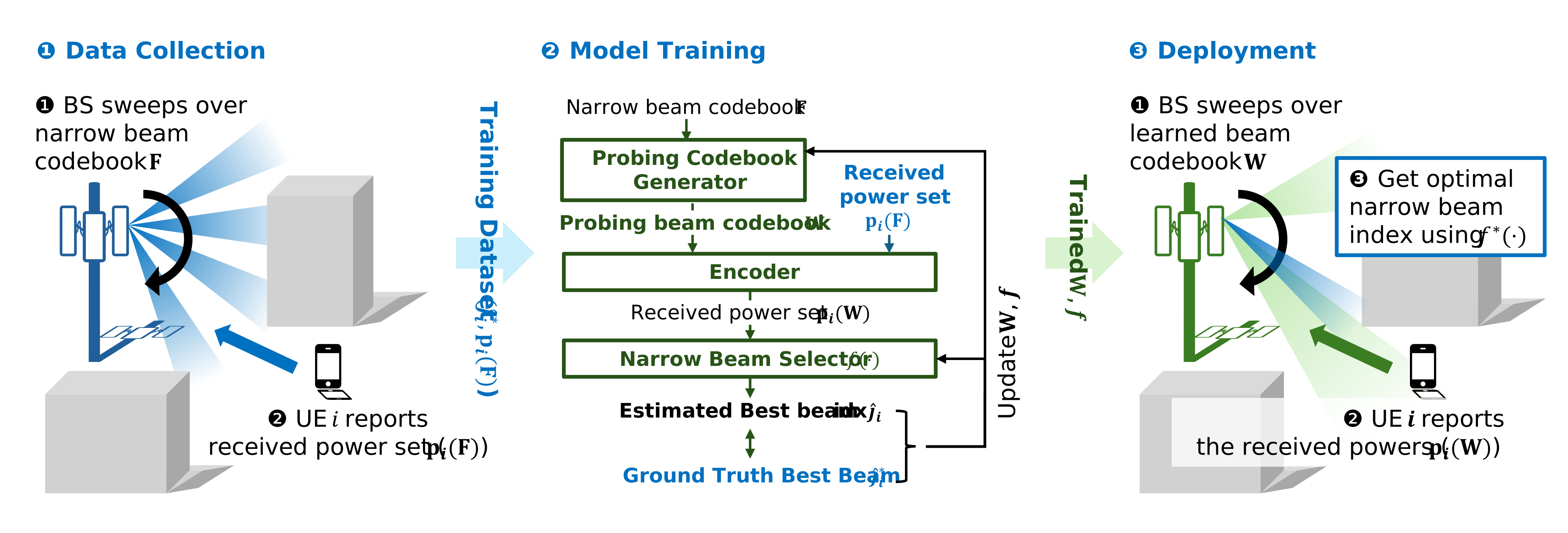
In this paper, we address the challenge of efficient beam alignment in wireless communications. Although recent studies demonstrate that deep learning-based methods can significantly accelerate site-specific beam alignment by leveraging propagation channel data between the base station (BS) and potential user locations, such datasets are impractical to acquire via exhaustive channel estimation and excessively time-consuming when using ray-tracing simulations. To overcome these limitations, we propose an innovative beam alignment framework that utilizes only noisy beam sweeping measurements, avoiding explicit channel estimation altogether. Our method involves training a model directly with these practically obtainable, noisy measurements, thus bypassing costly and impractical data acquisition processes. Specifically, the proposed approach constructs a dataset from beam sweeping measurements, enabling effective site-specific optimization without explicit knowledge of channel information. Simulation results confirm that our framework achieves beam alignment accuracy and speed comparable to state-of-the-art methods trained on perfect explicit channel datasets, demonstrating remarkable robustness even under significantly noisy measurements.
Why This Matters
Beam alignment gains often come from exploiting local propagation structure, but the price is environment-specific data collection. In many papers, that dataset is created with tools or labels that are far cleaner than what a real system can actually observe. This work closes that gap by building the learning pipeline around measurements that a beam-management system can realistically obtain.
That makes the contribution mainly about supervision design. The model is important, but the more important point is that practical supervision can be enough if the training target and dataset construction are chosen correctly.
What This Paper Does
Instead of building a supervised pipeline around ideal channel state information, the paper constructs the dataset from noisy sweeping responses. The method therefore reduces the cost of site adaptation while preserving the advantages of site-aware learning. That is a more realistic path to deployment than relying on exhaustive channel acquisition or ray-tracing labels.
The result is a beam alignment framework that remains grounded in the actual measurement pipeline rather than in an idealized offline labeling workflow.
Learned Probing Beam Patterns
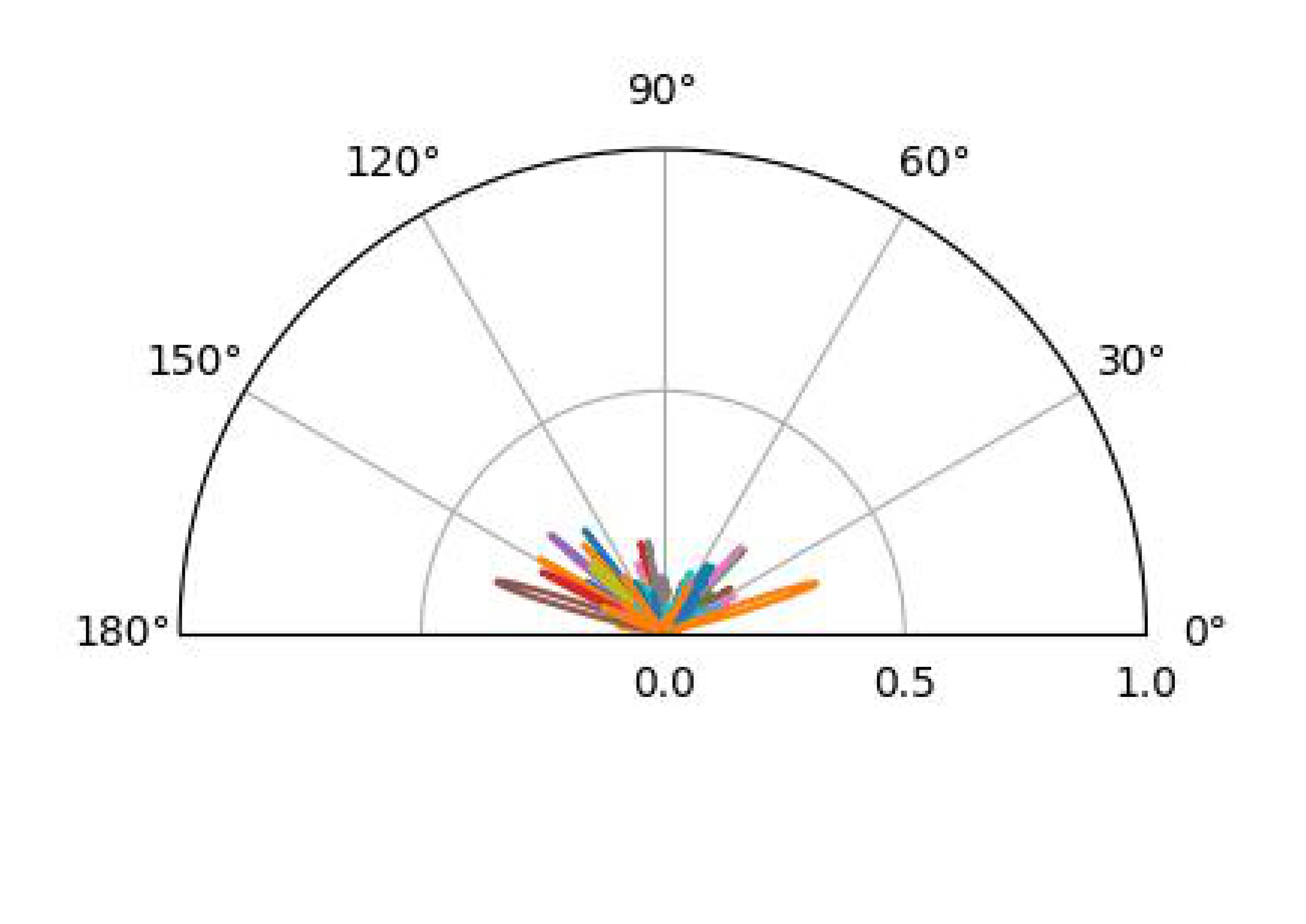
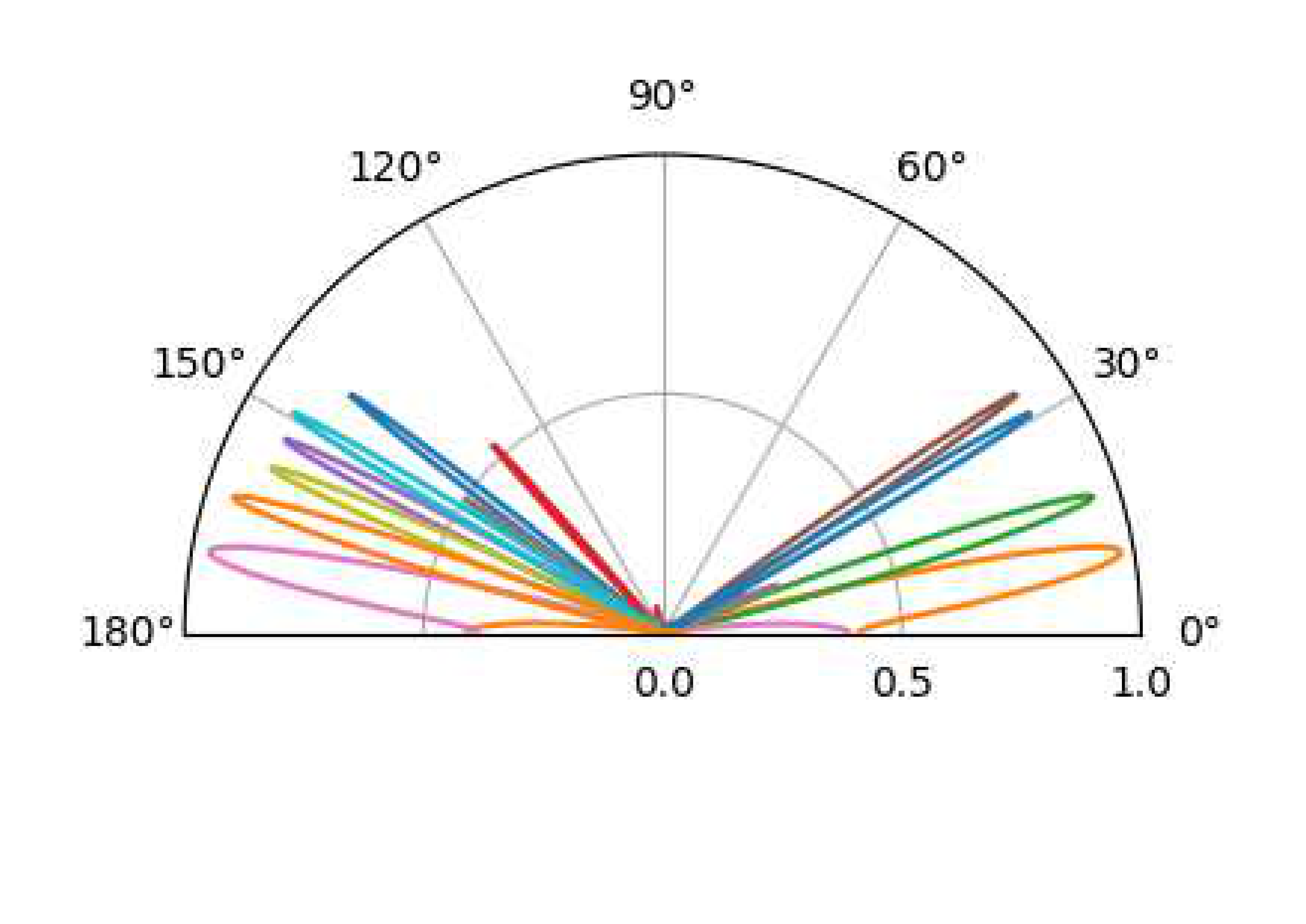
The learned probing codebook is not just a smaller subset of conventional DFT beams. It adapts its angular coverage to the site. In the mostly LOS Rosslyn environment, the learned probing beams are distributed more broadly, while in the DeepMIMO O1_28B environment they concentrate energy toward useful reflected paths and UE regions.
Achieved SNR With Low Overhead
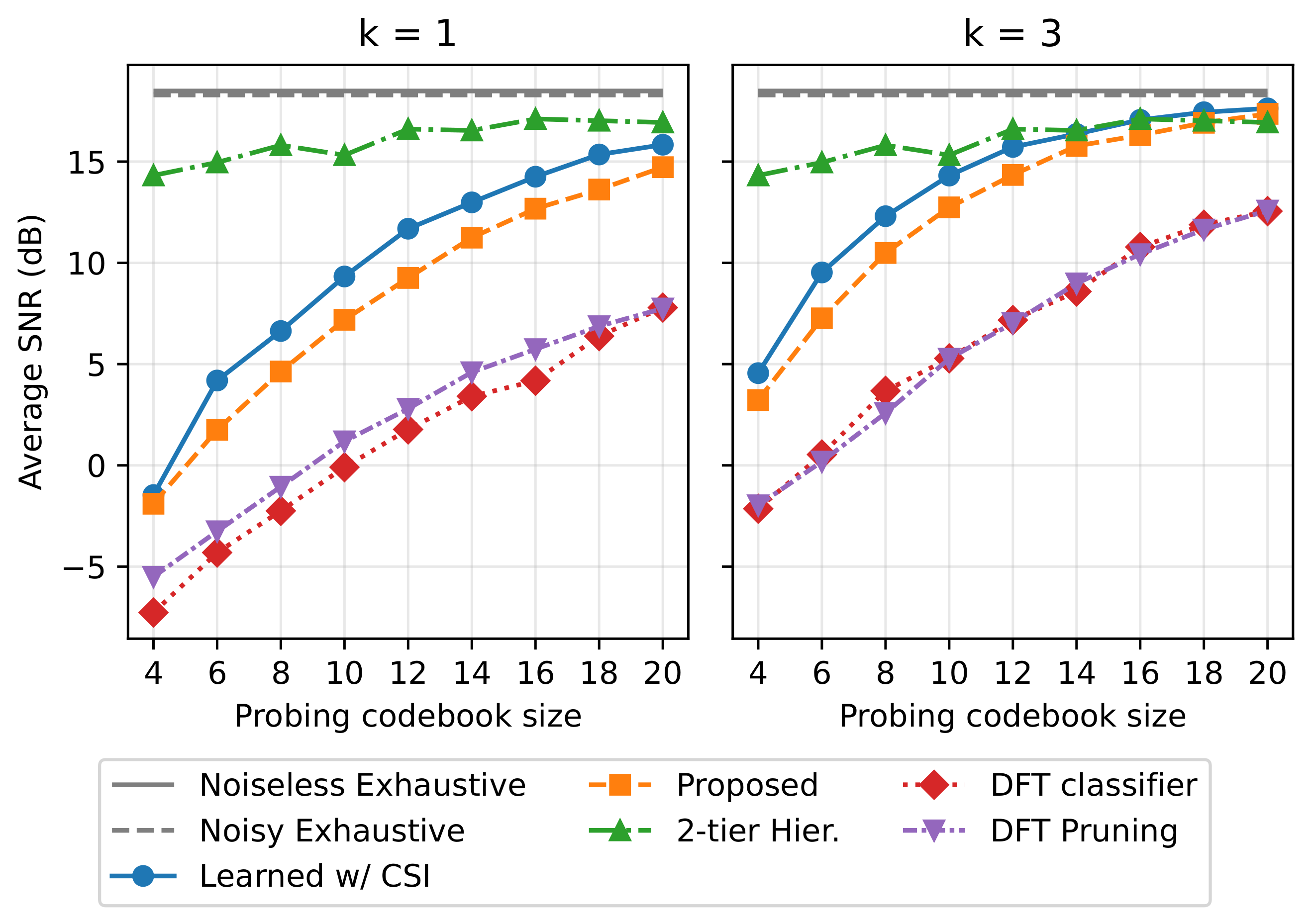
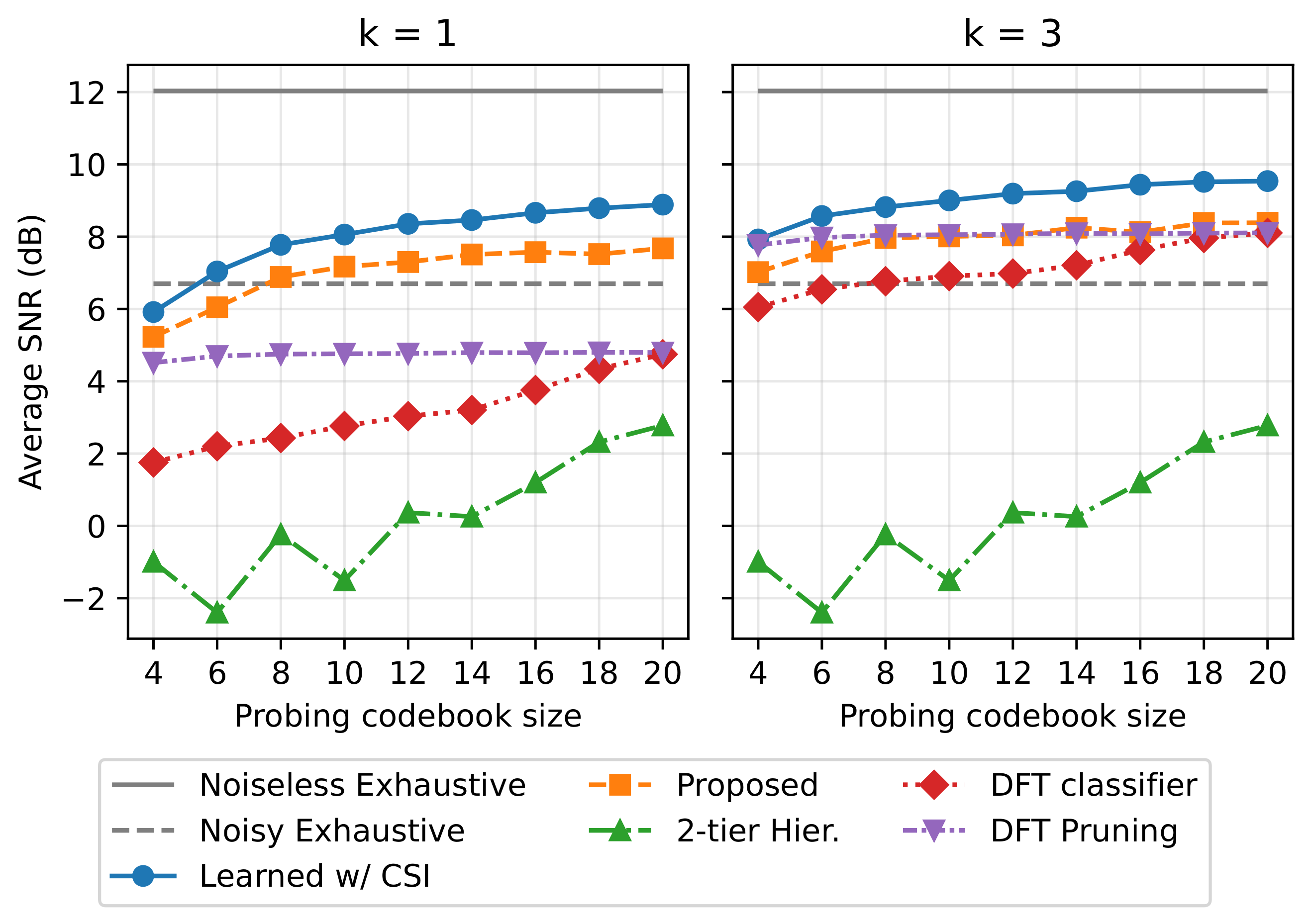
The practical metric is achieved downlink SNR after beam selection, not only whether the exact noiseless best-beam index is predicted. With top-$k$ refinement, the proposed method can recover most of the exhaustive-search SNR while probing far fewer beams.
Robustness to Measurement Noise
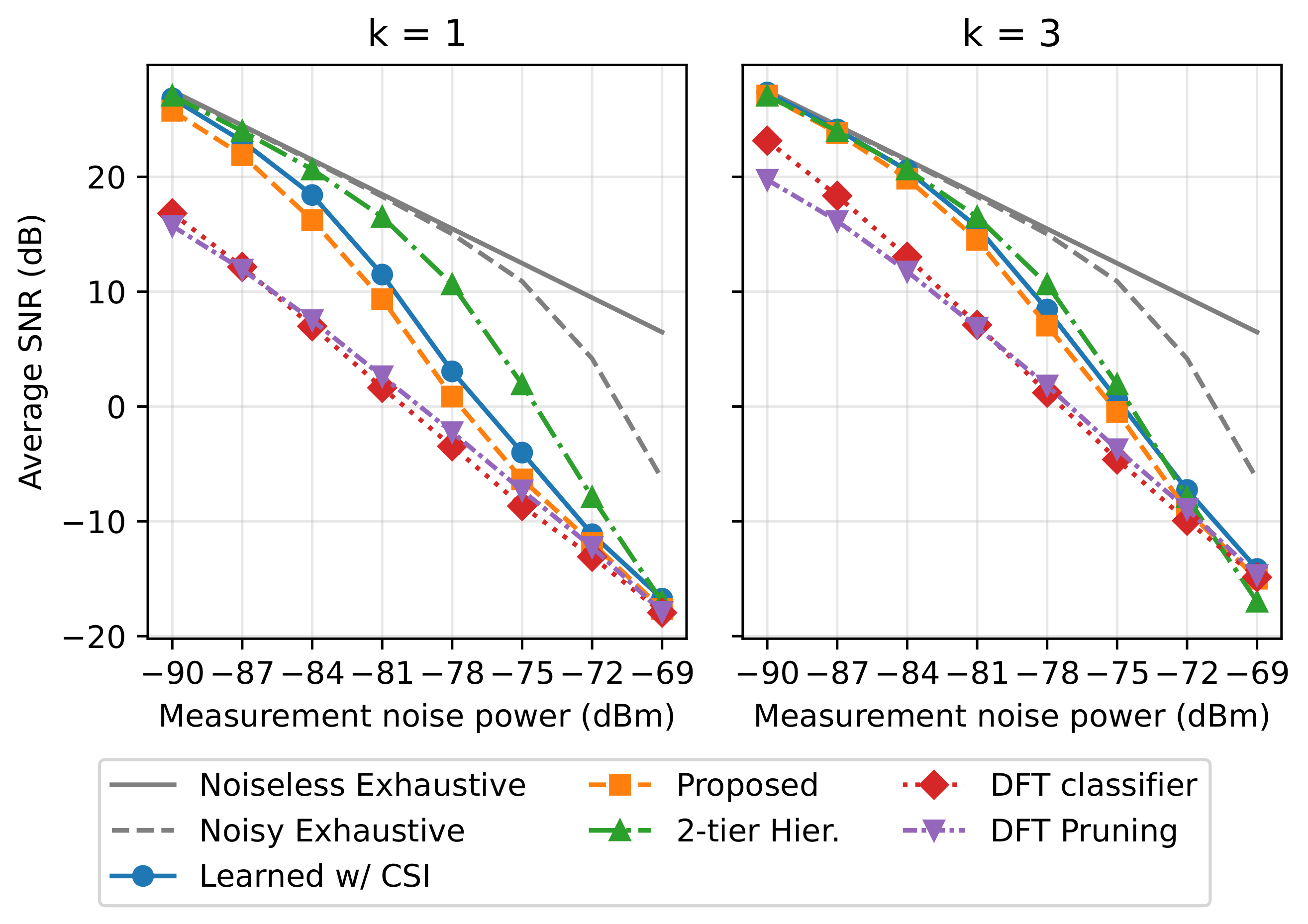
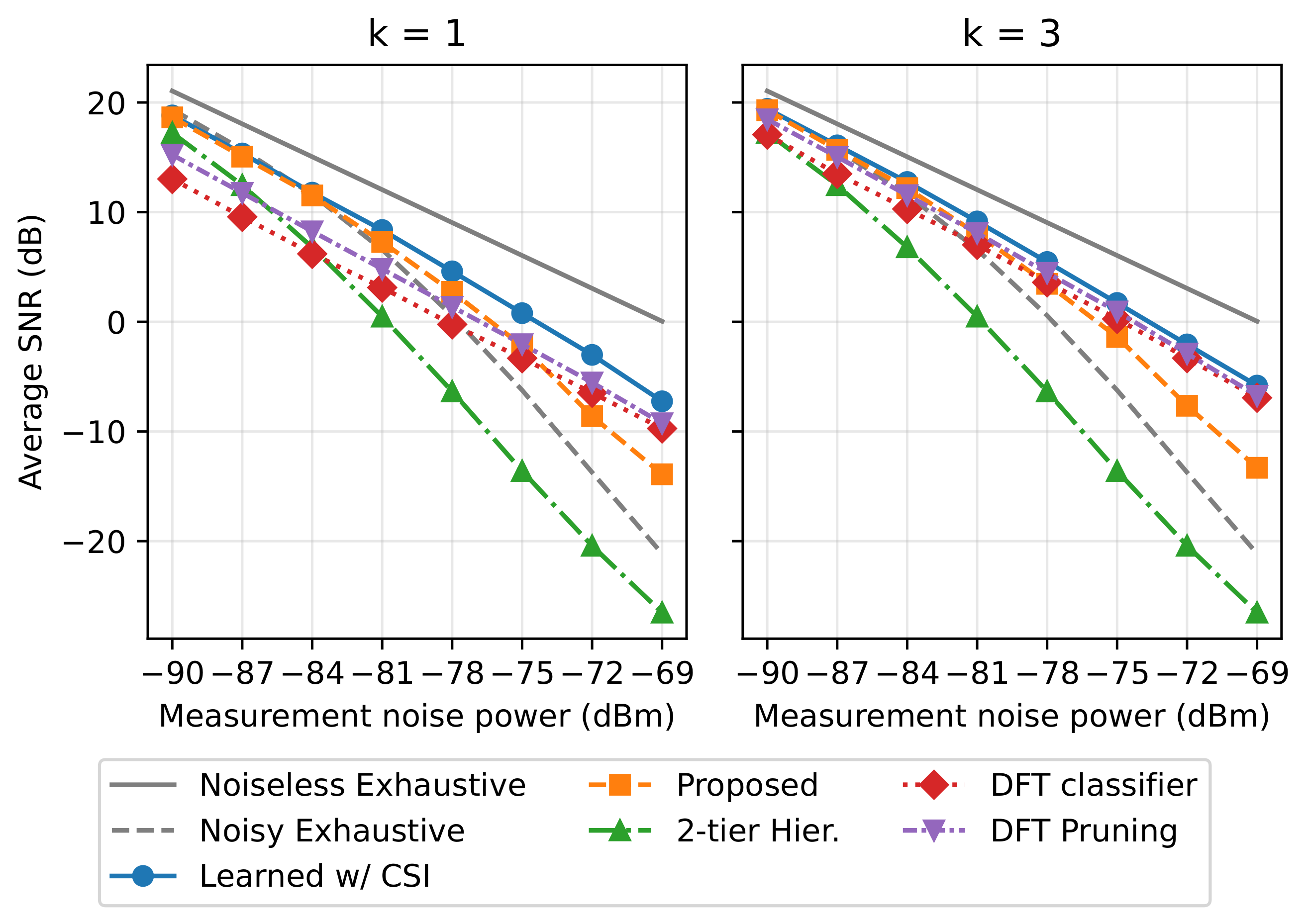
The method is trained and deployed with noisy power measurements. The SNR curves show that learned probing remains competitive across measurement-noise levels, especially in the NLOS DeepMIMO setting where naive exhaustive power selection can be corrupted by measurement noise.
Key Results
- The learned probing beams adapt to the deployment site, forming broad coverage in LOS-heavy Rosslyn and multi-lobe NLOS-aware patterns in DeepMIMO O1_28B.
- The proposed method approaches exhaustive-search SNR using far fewer probing beams, especially when a small top-$k$ refinement is allowed.
- In DeepMIMO O1_28B, the method can match noisy exhaustive search with 8 probing beams for $k=3$ or 14 probing beams for $k=1$.
- The remaining SNR gap to CSI-aided joint beam learning is modest, about 2 dB in Rosslyn and about 1 dB in DeepMIMO O1_28B.
- The framework stays practical because training uses noisy narrow-beam power measurements instead of explicit CSI or ray-tracing labels.
