Bridging Neural Networks and Wireless Systems with MIMO-OFDM Semantic Communications
real-world deployment issues in semantic MIMO-OFDM systems.
Abstract
Semantic communications aim to enhance transmission efficiency by jointly optimizing source coding, channel coding, and modulation. While prior research has demonstrated promising performance in simulations, real-world implementations often face significant challenges, including noise variability and nonlinear distortions, leading to performance gaps. This article investigates these challenges in a multiple-input multiple-output (MIMO) and orthogonal frequency-division multiplexing (OFDM)-based semantic communication system, focusing on the practical impacts of power amplifier (PA) nonlinearity and peak-to-average power ratio (PAPR) variations. Our analysis identifies frequency selectivity of the actual channel as a critical factor in performance degradation and demonstrates that targeted mitigation strategies can enable semantic systems to approach theoretical performance. By addressing key limitations in existing designs, we provide actionable insights for advancing semantic communications in practical wireless environments. This work establishes a foundation for bridging the gap between theoretical models and real-world deployment, highlighting essential considerations for system design and optimization.
Why This Matters
The paper is valuable because it does not stop at showing that hardware is worse than simulation. It explains why. In semantic communications, that distinction matters because the learned model is sensitive to the exact error statistics it sees. Once real channels, equalization errors, and nonlinear RF effects enter the loop, the decoder no longer sees the synthetic impairment model it was trained on.
That turns the work into more than a prototype report. It acts as a diagnostic paper for real-world semantic communications and clarifies where later waveform and interface-level improvements should be targeted.
What This Paper Does
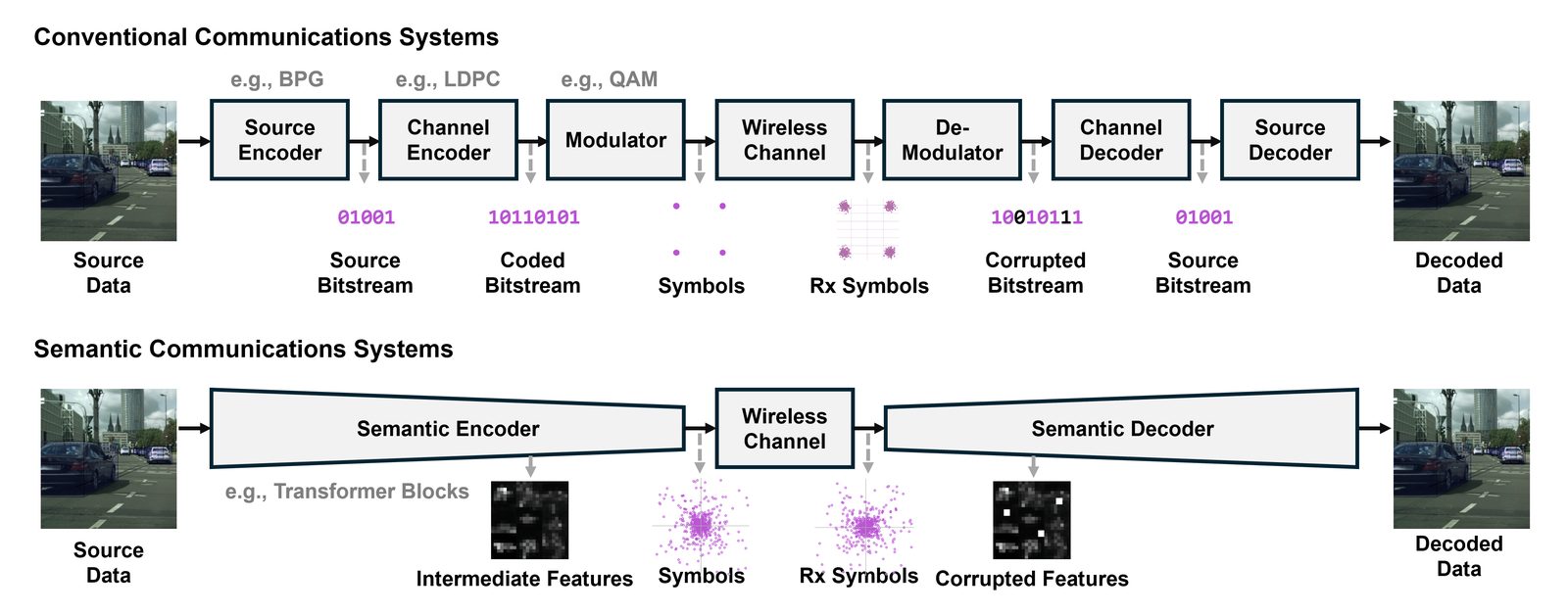
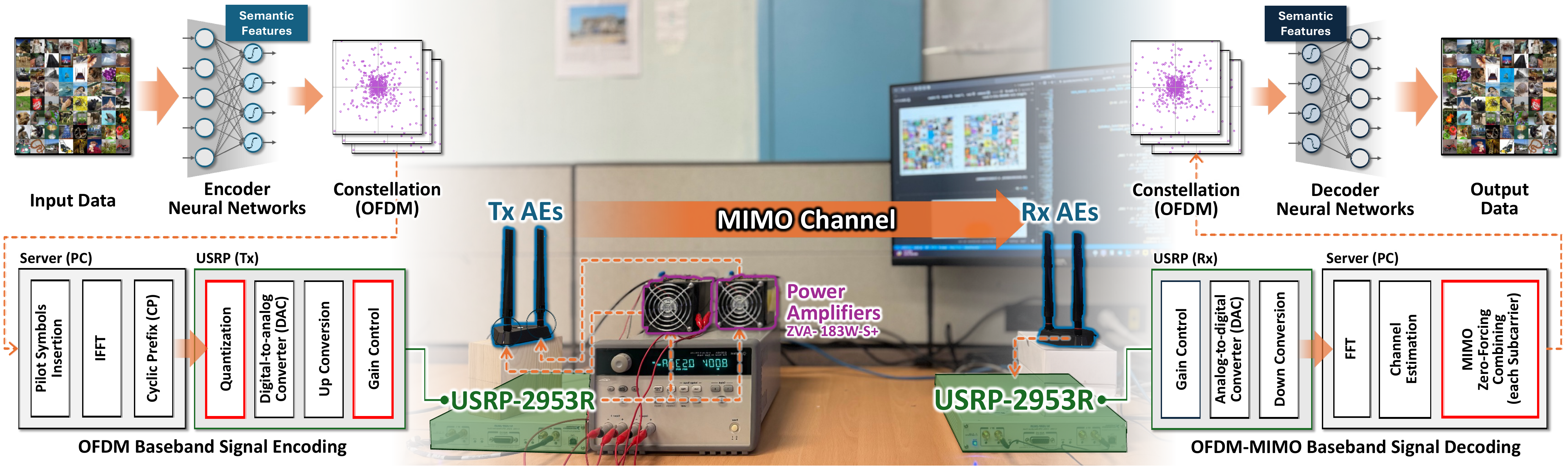
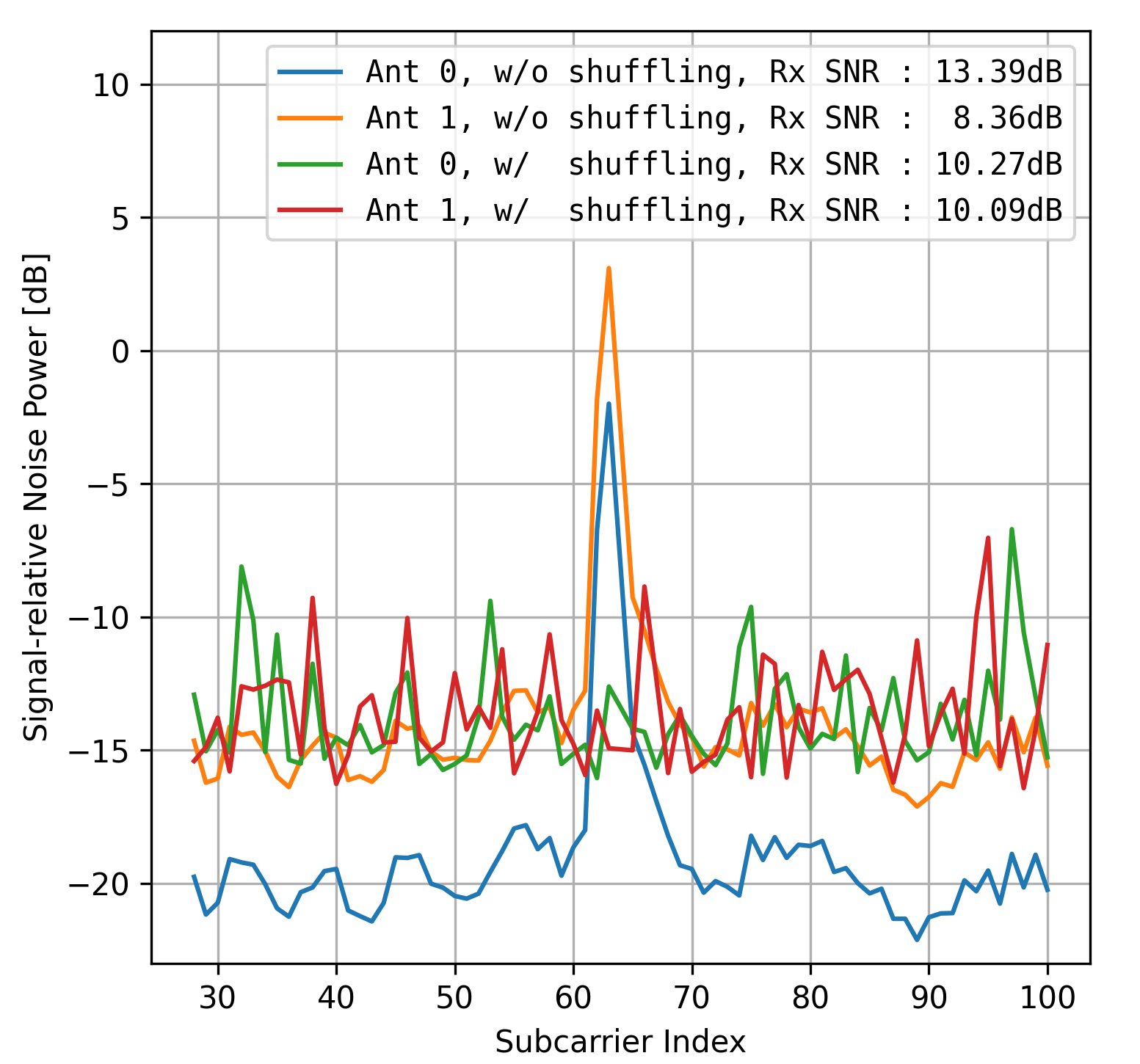
The prototype is used as an instrument for analysis rather than only as a demo. The paper isolates the effects of subcarrier-wise error variation, symbol shuffling, PA nonlinear distortion, and PAPR control, and then relates those physical effects to semantic reconstruction quality. That gives a rare end-to-end view linking neural communication performance to concrete RF impairments.
The result is a bridge between learning and wireless system engineering: it shows what the neural model expects, what the real channel delivers, and how the mismatch appears in measured performance.
Key Results
- Frequency selectivity is identified as a major reason for the deployment gap in semantic OFDM systems.
- PA nonlinearity and PAPR behavior are shown to materially affect learned transmission quality.
- The work provides an over-the-air baseline that ties semantic model behavior to concrete RF impairments.
- Its main contribution is practical guidance: robust semantic communications require physical-layer design choices that respect actual hardware statistics, not only idealized channel models.
PAPR and PA Nonlinearity
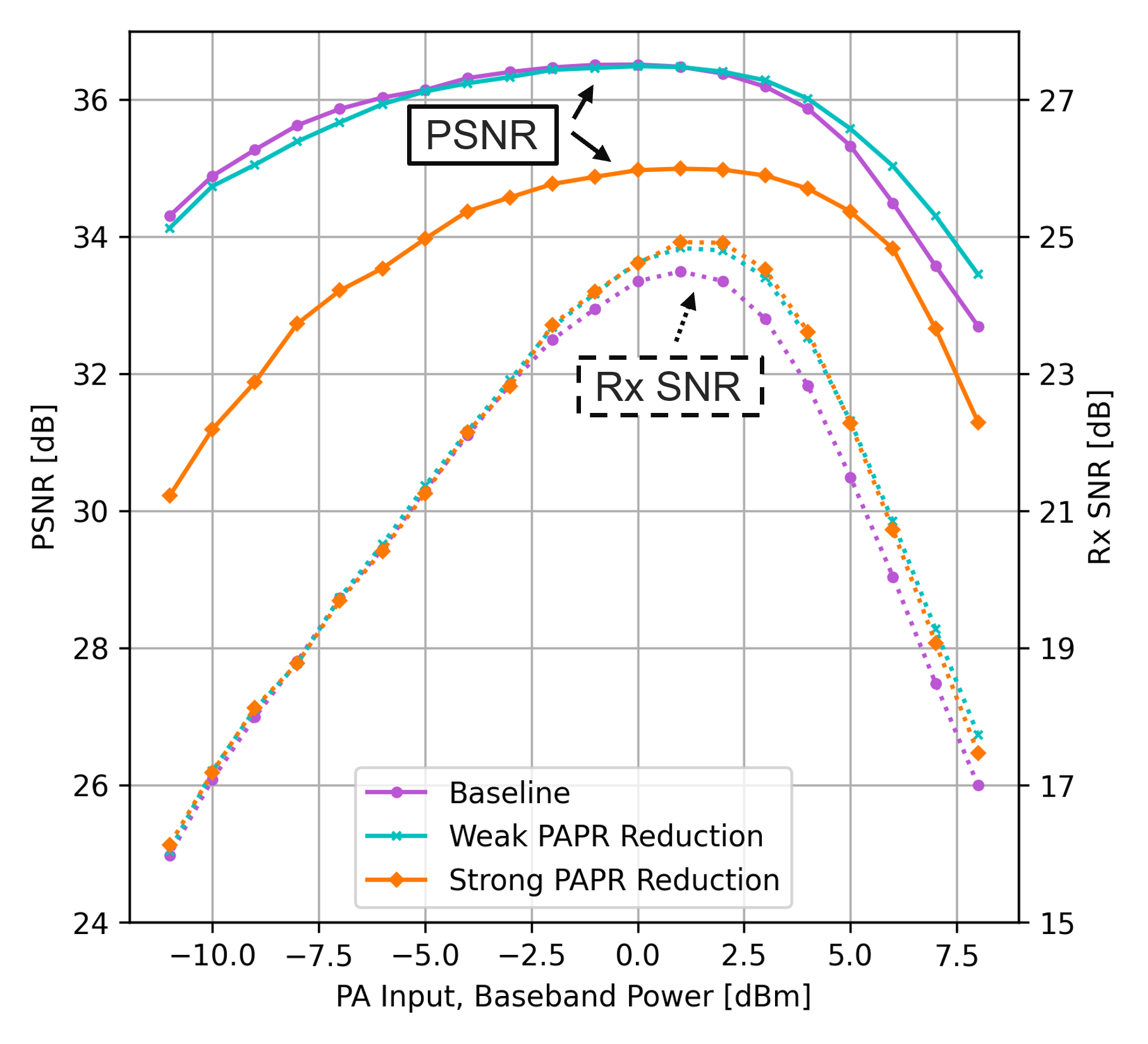
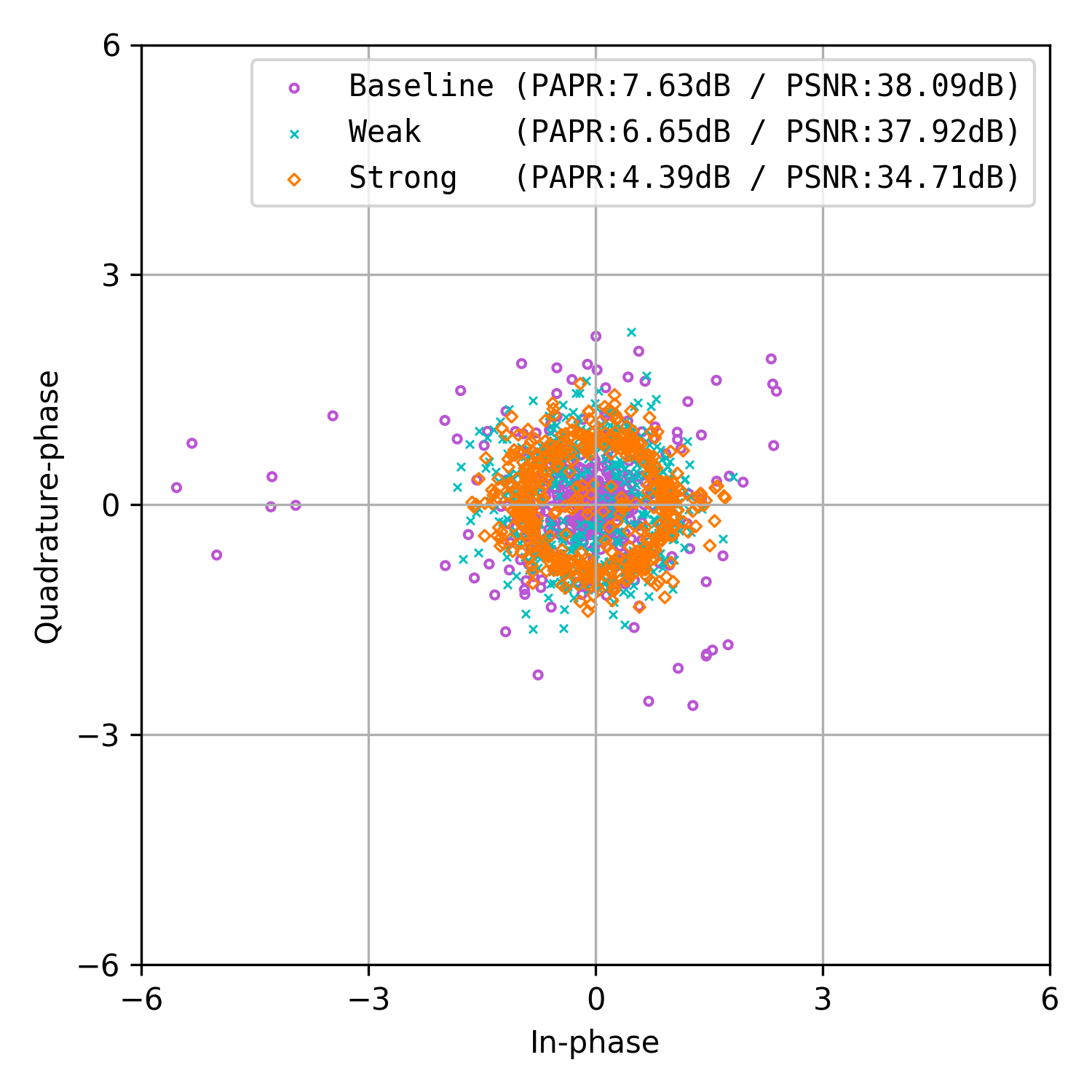
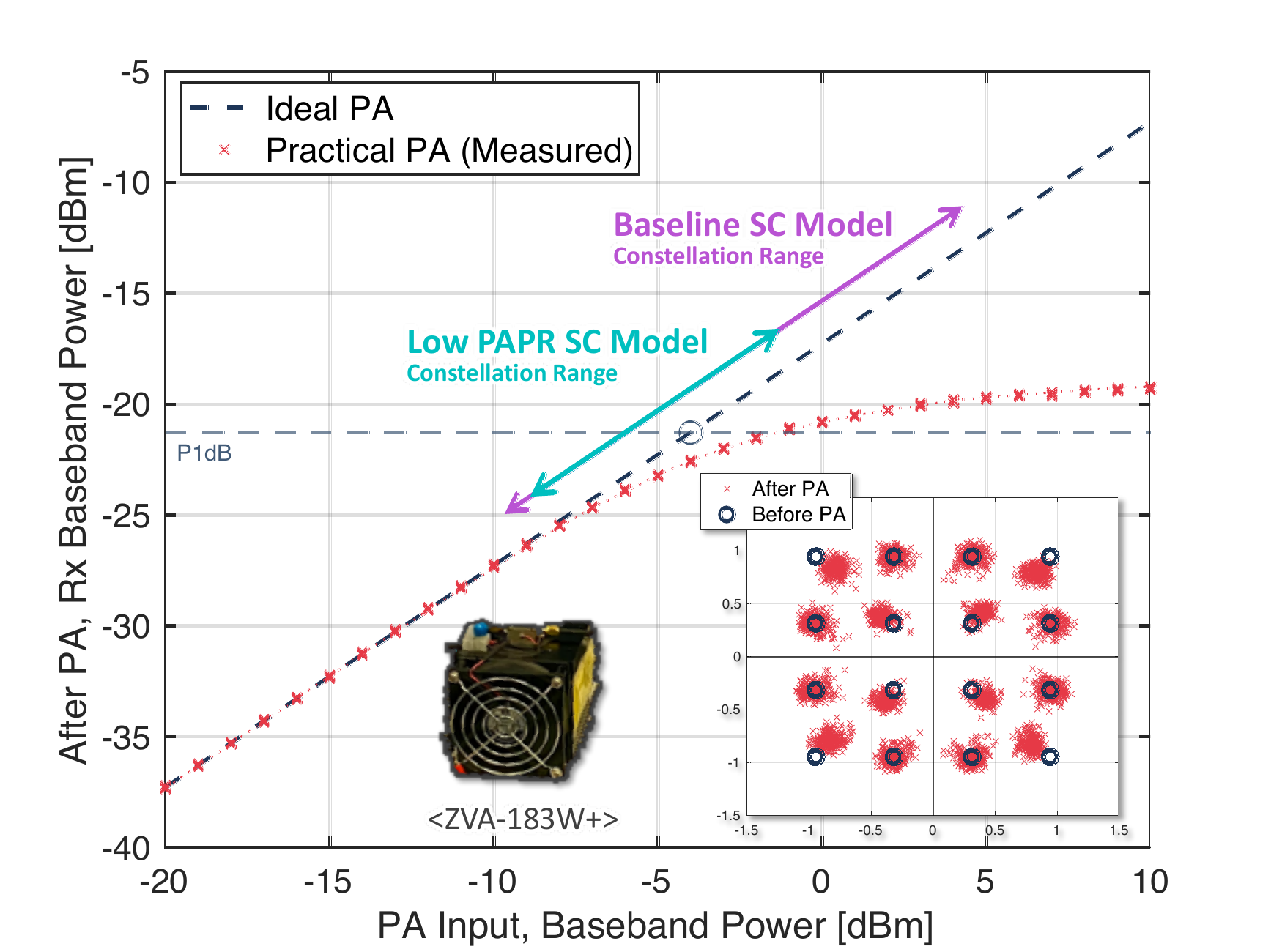
The paper also shows why semantic systems cannot ignore RF peak behavior. PAPR-constrained semantic models change both the constellation cloud and the OFDM waveform peak statistics. When those peaks enter a nonlinear PA region, reconstruction quality degrades in a way that is not captured by ordinary AWGN simulation.
PSNR Results
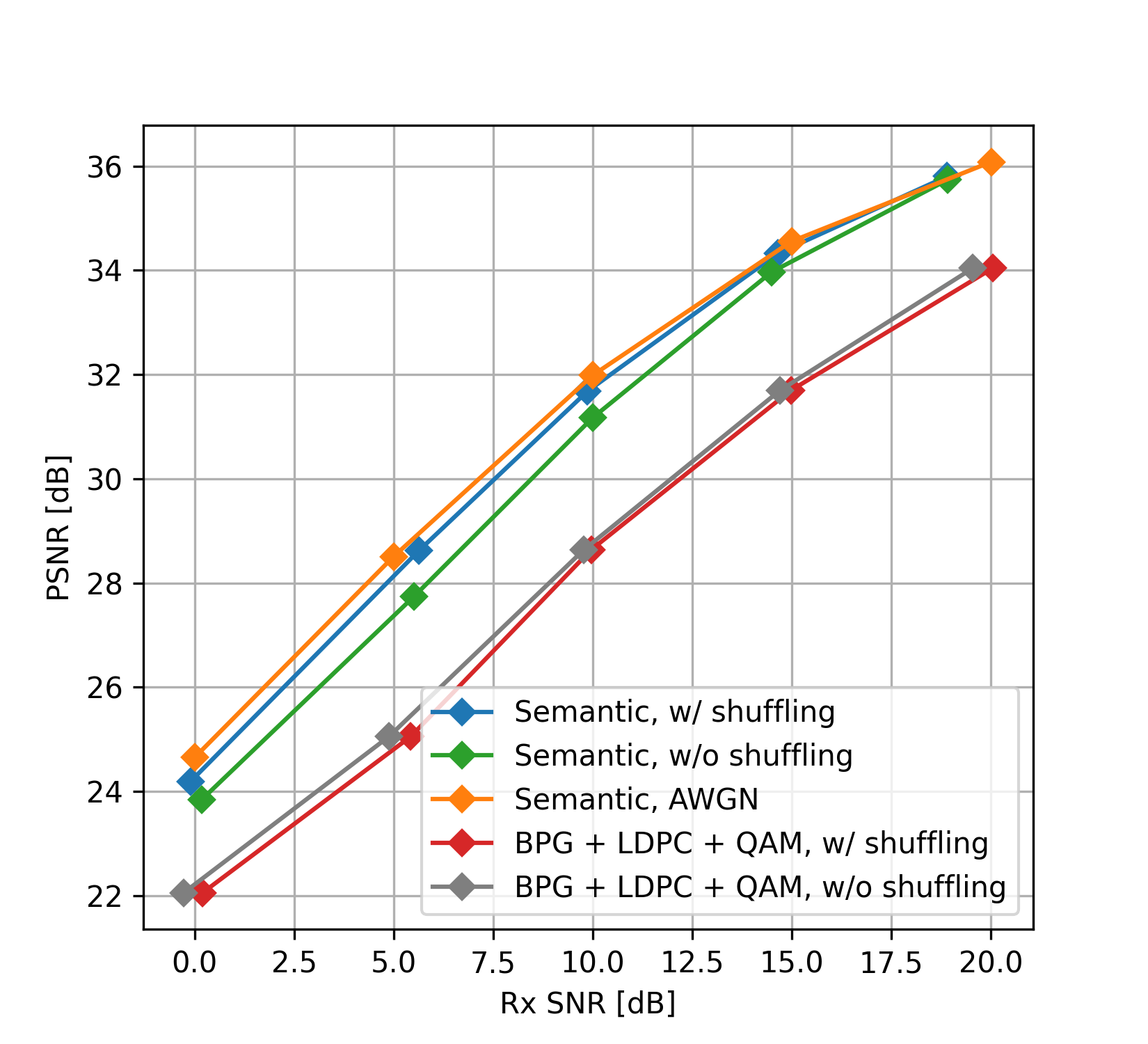
The performance plots connect the RF measurements back to the semantic task. In the linear region, MIMO-OFDM semantic transmission is compared against simulation and OFDM-LDPC. In the nonlinear region, PAPR-aware training mitigates the PA-induced quality loss.